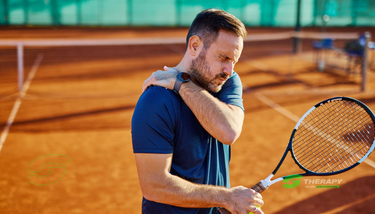
In Doral and Miami, more and more people are playing tennis and pickleball as part of an active lifestyle. The problem is that many begin to experience pain in their shoulder, elbow, or even wrist and initially ignore it. Big mistake.
Because that pain that today “only bothers me a little” often tomorrow limits their serve, backhand, grip strength, or even simple daily tasks like lifting a bag, opening a door, or sleeping on the affected side.
At G Therapy Center Miami, we frequently see patients who arrive after weeks or months of playing with discomfort, thinking that “it will go away on its own.” Sometimes it does. But often it doesn’t. And the longer you let it go, the harder it becomes to recover properly.
Why does pain appear when playing tennis or pickleball? It’s usually not due to a single cause. It’s almost always a combination of several factors:
Poor hitting mechanics
Sudden increase in workload or playing frequency
Stiffness in the shoulder, thoracic spine, or neck
Rotator cuff and scapula weakness
Lack of recovery time
Improper grip or excessive forearm strain
Returning to play too quickly after a break
The body compensates for everything. Until it stops compensating.
Most common areas of pain
Pain on the side of the elbow: Many people call this «tennis elbow,» although it’s also common in pickleball players.
It’s usually felt when gripping tightly, lifting objects, turning a key, or hitting a backhand.
Pain on the front or side of the shoulder: This can occur when serving, raising the arm, accelerating the swing, or sleeping on that side.
It’s often related to rotator cuff overload, poor scapular stability, or lack of mobility.
Forearm or wrist pain
Very common in people who grip the paddle or racket too tightly, or who play many repetitions without good technique or sufficient rest.
Neck and upper back tension
This happens more often than people realize.
When shoulder mechanics fail, the neck and trapezius muscles try to do extra work.
Signs you shouldn’t ignore it
Some people want to hear «it’s nothing.»
But if you have one or more of these signs, it’s wise to get it checked out:
Pain that lasts more than 7 to 10 days
Discomfort that worsens when playing
Loss of strength
Nighttime pain
A stabbing sensation when raising your arm
Difficulty serving, hitting, or gripping firmly
Stiffness that doesn’t improve with short rest
Pain that starts mild but gets worse each week
That’s not «normal from training.»
That’s a warning sign.
What Many People Do Wrong
Here’s the typical pattern:
«It hurts, I rest for two days, I feel better, I go back to playing just as hard, the pain returns, I ice it, I keep playing, it gets worse.»
That’s not recovery. That’s mismanaging the problem until it becomes a bigger one.
Many people also make the mistake of only seeking a quick massage or only taking anti-inflammatories without addressing the underlying mechanical cause. Reducing the pain without addressing the root cause isn’t solving the problem. It’s postponing it.
What to Do When Pain Appears
Reduce the load, not your intelligence. You don’t always have to stop completely, but you do need to adjust intensity, volume, and frequency. Continuing the same routine when your body is already complaining is a bad strategy.
Check Mobility and Control. If your shoulder doesn’t move properly, if your scapula doesn’t stabilize well, or if your chest is stiff, your elbow and neck will end up paying the price.
Work on Specific Strength Training. Simply «exercising» isn’t enough.
We need to strengthen what truly protects the athletic movement:
rotator cuff
scapula
forearm
core
posterior chain
Correct patterns before they become chronic. Many sports-related pains don’t begin with an acute injury, but rather with the accumulation of repeated micro-errors.
When should you seek professional help?
You should seek an evaluation if:
the pain returns every time you play
you’ve lost power or confidence in your stroke
you feel weakness or fatigue too quickly
your shoulder feels unstable
your elbow burns or hurts even off the court
you’ve had the problem for weeks and it’s not really improving
Waiting too long is often more costly in terms of time, performance, and frustration.
How we approach these cases at G Therapy Center
At G Therapy Center, we don’t just work on the area where it hurts.
We look for why it’s happening.
Our approach may include, depending on the individual case:
Functional movement assessment
Manual therapy
Muscle tension release
Mobility work
Specific activation and strengthening exercises
Correction of mechanical patterns
Safe progression back to activity
The goal isn’t just to «feel less pain.»
The goal is for you to move better, regain confidence, and return to playing with more control and fewer setbacks.
If you play in Doral or Miami, this is for you.
If you play tennis or pickleball in Doral, Miami, or the surrounding area, don’t wait for a minor ache to sideline you for weeks.
The sooner you identify the problem, the easier it usually is.
Correct it.
The longer you put it off, the more compensations appear.
And no, playing through pain doesn’t make you disciplined. It makes you reckless. Shoulder or elbow pain from playing tennis or pickleball shouldn’t be normalized. It may start as a simple annoyance, but if you don’t address the cause, it ends up affecting your performance, your rest, and your daily routine.
If you already feel pain when serving, hitting, raising your arm, or gripping tightly, it’s time to stop improvising.
At G Therapy Center Miami, we help you identify the real cause of the problem and build a smart recovery, not a temporary fix.
Does your shoulder or elbow hurt after playing?
Schedule your evaluation at G Therapy Center Miami and take action before the problem worsens.